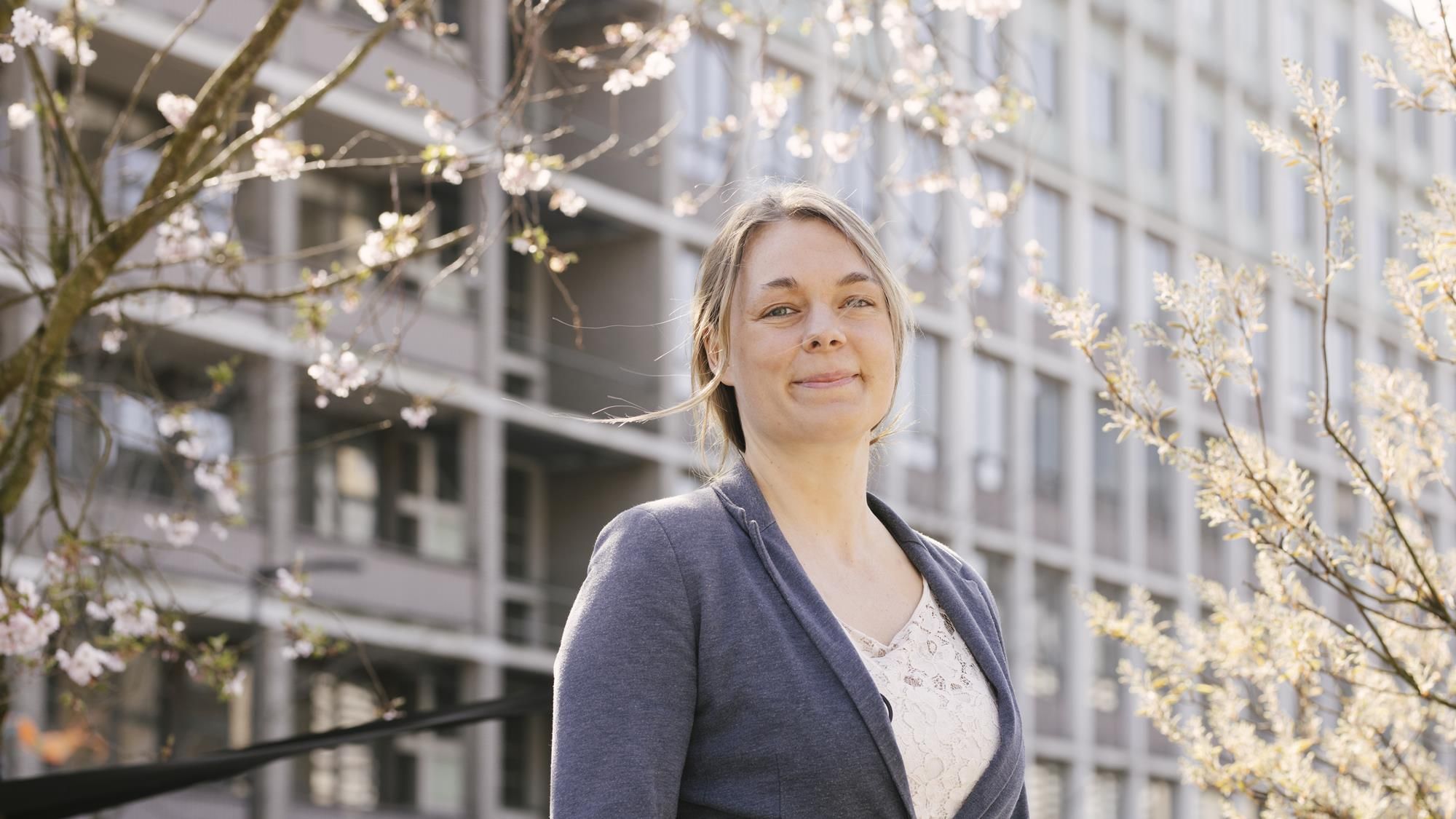
Marthe Wens is an Assistant Professor in the Water and Climate Risk group of th Instititute for Environmental Studies at VU Amsterdam.
Educated as and interdisciplinary geographer, investigates drought risks at the human-water-climate interface. Her research concerns water security and societal impacts spanning both physical systems and human decision-making fields. She applies socio-hydrology, behavioural science, complex adaptive systems thinking, co-creation and disaster risk reduction frameworks and is expert in integrated modelling, qualitative-quantitative integration, particiaptory research and climate risk assessment. Besides, she likes to work on the science-policy interface. She is a climate justice activist and enjoys working on resilience projects together with partner institutes from the Global South.
dr. Marthe Wens
Marthe's research concerns water security and societal impacts, with a specific focus on simulating the intertwined nature of drought risk and human adaptive behaviour. Most of her work focuses on Europe or Africa, and on agricultural droughts, but recently her work is broader and includes drought impacts on other sectors (e.g. ecosystems) and aspects of society (e.g. children, migration). She investigates the use of agent-based modelling and machine learning tools to create global, national, and local drought profiles and joins co-creation efforts to co-design adaptation pathways - with the overall aim to support decision making on drought risks mitigation.
2016: Master of Science in Geography, Major Earth & Climate studies,
Minor: GIS and Spatial Modelling
(KU Leuven and VUB Brussels, Belgium)
Wens, M. (2016). Cost-benefit evaluation of soil and water conservation techniques in Tigray.
MSc thesis including 3 months fieldwork executing Choice Experiment and SWC surveys on field
No ancillary activities
Ancillary activities are updated daily