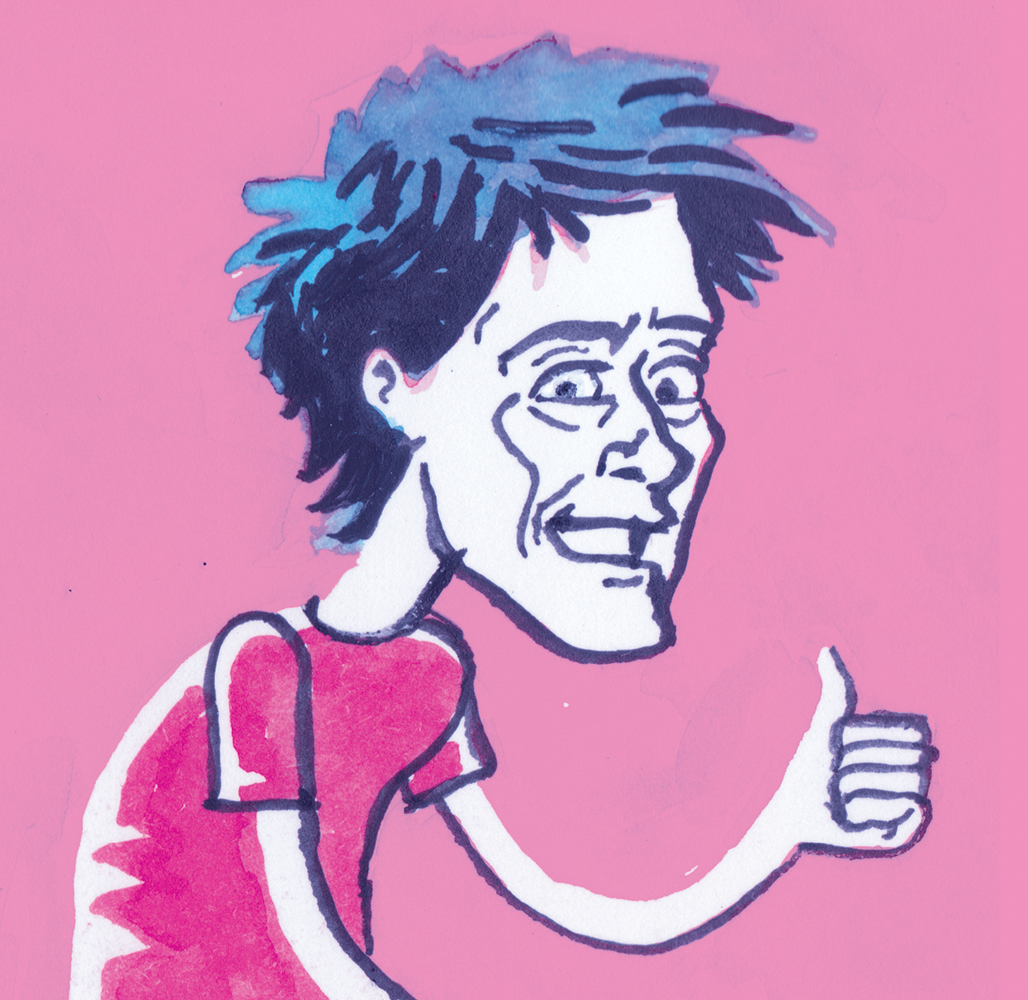
In the past five years my practice has been focused on Graphic Medicine, often defined as “the intersection of the medium of comics and the discourse of healthcare”. My first comic in this field, which dealt with the experience of being diagnosed with multiple sclerosis, was produced during a post-doctoral residency at London College of Communication. It was voted “best one shot” in the 2020 Broken Frontier awards and is held in the Wellcome Collection library. Subsequent comics have appeared in publications shortlisted for Council of Editors of Learned Journals and Eisner awards.
This context informs much of my project supervision and teaching, from undergraduate to doctoral projects.
In addition to my research position at the VU I am a Senior Lecturer in Illustration at Kingston University, London.
I also have a long-standing research interest in visual metaphor, initially explored in my PhD and subsequently developed into a monograph. This line of research was sparked by my interest in producing wordless comics, particularly my project Babel, which was highlighted in Tate / Yale UP’s introduction to Comics Art.
Research
My approach to the creation and analysis of graphic communication is guided by my interest is how drawing style creates narrative meanings by guiding audiences' expectations regarding genre, mood and character. I explored this from a theoretical perspective in my PhD (Visual Metaphor and Drawn Narratives, Central Saint Martins, 2017), and my monograph Visual Metaphor and Drawn Narratives.
More recently I have applied this approach in the field of Graphic Medicine, as described above. Discussions of how these two strands of research intertwine can be found in my contribution to Seeing Comics Through Art History: Alternative Approaches to the Form, and in the final chapter of my monograph.
I am a passionate advocate of creative practice as a research method and form of dissemination; many of my recent peer-reviewed articles have been in comics form, and allm of my recent written outputs include original drawings created as demonstrations of their theoretical arguments.
With Erin la Cour, I co-supervise Lucie Morel’s doctoral research.