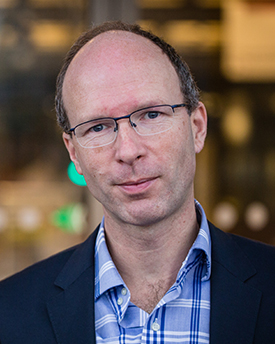
Trained as an Earth Scientist, Jeroen Aerts has been the international forefront of modelling flood risks and other natural hazards for more than 30 years. At the basis of his work are quantitative risk assessment methods combining hydrological models and behavioural models showing how people respond to flood risk --depending on both changing hydrological and socio-economic conditions. Jeroen's work has been published in 281 peer reviewed papers of which 33 publications in Nature, Science and PNAS (H index ggl: 104). From 2019 onwards, he is awarded as the top 1% highly cited researcher globally, by Web of Science.
Honours:
- ERC Synergy Grant (2025; 2,5 mln Euros).
- Member KNAW (2025; Royal Netherlands Academy of Art and Sciences)
- Member KHMW (2021; The Royal Holland Society of Sciences and Humanities)
-Humboldt Research Award (2021)
- ERC Advanced Grant (2020; 2.5 mln Euros)
- AGU Gilbert F. White Award (2019)
- NWO-VICI Grant (2014; 1.5 mln Euros)
Career:
Jeroen started his career as hydrological modeller at the UvA (University of Amsterdam) under supervision of prof. Willem Bouten. He then worked as a GIS specialist at Resource Analysis ltd in Delft. After conducting a PhD at UvA (prof. Gerard Heuvelink) and the University of California, Santa Barbara (UCSB; prof. Keith Clarke;prof. Michael Goodchild), Jeroen started working in 2002 at VU University Amsterdam. In 2007 he was appointed at the VU Amsterdam to a chair in Risk and Insurance, and in 2012 to a second chair in Risk and Water management. Jeroen currently supervises a research group, with 14 academic staff, 42 PhD students and 8 post-docs addressing various aspects of water and climate risk management. From 2015 to 2020, Jeroen Aerts was director of the Institute for Environmental Studies (IVM) with a total of 240 Staff and PhD’s divided over 4 departments. From 2014-2020 he was programme director of the MSc Hydrology programme.
Research:
To assess the interactions between society and the flood and droughts, he has developed and applied a wide range of assessment and modelling methods to analyse water risk (flood/drought) and climate adaptation at scales from local to global. The methods include: hydrological modelling, risk modelling, agent-based modelling, scenario analysis, adaptation pathways, and optimization. In various papers, he showed the importance of addressing flood adaptation by households and that local scale flood adaptation can reduce flood risk by >25% --even at larger scales. For this, he coupled a global-scale agent-based model to a fully dynamic hydrological model in an ERC Advanced project, simulating for the first time flood management decisions of 200 million individuals. In a paper in Nature Water, he shows there are, however, limits to the human capacity to adapt to future flood risk. The paper is the basis for a new ERC Synergy project (2026-2032) on flood adaptation limits (LIMIT2ADAPT).
Research network and key projects:
Jeroen has developed an internationally recognized flood risk research group, in close collaboration with MIT, Princeton, UCSB, GfZ, Oxford University, Wharton, IIASA, Columbia University, CMCC, and London School of Economics. In the early 2000-s, Jeroen co-initiated the first large scale climate adaptation research programme in the Netherlands (‘Klimaat voor Ruimte’ with prof. Pier Vellinga and prof. Pavel Kabat). In this program (110 Million Euros) he was responsible for the setup and coordination of all climate adaptation research projects (24 mln Euros). In 2010, Jeroen co-initiated a second FES-funded programme: ‘Knowlegde for Climate’, and was responsible for the coordination of all river and climate adaptation projects. Jeroen was scientific coordinator of the Connecting Delta Cities initiative under the Bill Clinton C-40 global cities network, and Co-authored the OECD report on Water Security. His international work also includes research with Munich RE, Red Cross, Worldbank, and UNISDR. Jeroen was advisor to Mayor Bloomberg of New York City on flood risk resilience issues, before and in the aftermath of Hurricane Sandy. He was the coordinator of the EU ENHANCE project on risk and Natural Hazards.
Expertise
Floods, Droughts, Hydrology, Risk assessment, Insurance, Decision making, Adaptation, Climate change.