Education Research Current About VU Amsterdam NL
Login as
Prospective student Student Employee
Bachelor Master VU for Professionals
Exchange programme VU Amsterdam Summer School Honours programme VU-NT2 Semester in Amsterdam
PhD at VU Amsterdam Research highlights Prizes and distinctions
Research institutes Our scientists Research Impact Support Portal Creating impact
News Events calendar Healthy living at VU Amsterdam
Israël and Palestinian regions Culture on campus
Practical matters Mission and core values Entrepreneurship on VU Campus
Governance Partnerships Alumni University Library Working at VU Amsterdam
Sorry! De informatie die je zoekt, is enkel beschikbaar in het Engels.
This programme is saved in My Study Choice.
Something went wrong with processing the request.

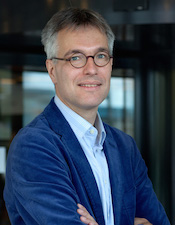
prof. dr. ir. Erwin Peterman


Full Professor, Faculty of Science, Physics of Living Systems

Full Professor, LaserLaB, LaserLaB - Molecular Biophysics

Personal information

He received his PhD from the VU in 1998. After a postdoc with Dr. W.E. Moerner at UC San Diego and at. Stanford. In 2000, he returned to the VU to start his own group. He is recipient of prestigious personal grants (NWO Vidi, Vici, ERC AdG). Since 2013 he is full professor Physics of Living Systems. He has been director of the BSc and MSc programs Medical Natural Sciences, and of LaserLaB Amsterdam, as well as head of our department. 

Erwin Peterman | Physics Living Systems | Department of Physics and Astronomy
Research

Lab website: https://www.nat.vu.nl/~erwinp

Erwin Peterman is interested in understanding how life works at the fundamental, single-molecule level. With his experiments he strives to provide quantitative insights in life processes that can be rigorously tested using physical models. To this end, he applies a multidisciplinary approach including elements from molecular and cellular biology, biochemistry, statistical physics and optics. The techniques used in his lab are (single-molecule) fluorescence microscopy, fluorescence spectroscopy and optical tweezers.

Current research focuses on the cooperation of motor proteins in intracellular transport in C. elegans cilia, on the mechanics of DNA and DNA-processing proteins, on the dynamics of membrane proteins in living bacteria, and on the development of new instrumentation and approaches to study life at the single-molecule level.

Education

B.Sc. & M.Sc.: Molecular Sciences, Wageningen University, 1988-1993.

Ph.D.: Chlorophylls and Carotenoids in Oxygenic Photosynthesis, VU University Amsterdam, Promotors: van Grondelle & van Amerongen, 1993-1998.

Teaching

Peterman teaches several courses at the bachelor's and master's level to students in Physics, Medical Natural Sciences, and Biomolecular Sciences, in particular "Microscopy and Spectroscopy" and "Mechanics and Thermodynamics in the Cell". He frequently supervises BSc and MSc research projects.

Prizes and Awards

In 2003 Peterman received a five-year VIDI grant from the Netherlands Organization for Scientific Research (NWO), in 2011 a VICI grant. In 2013, he was appointed as full professor on a University Research Chair. In 2017 he was awarded the NWO Physics Valorization prize (together with Gijs Wuite). In 2018 Peterman received an ERC Advanced grant.

Ancillary activities
  • LUMICKS B.V. | Amsterdam | Oprichter / aandeelhouder / adviseur | 2018-04-15 - present
  • Epifluorescence B.V. | Amsterdam | Directeur/eigenaar | 2018-04-15 - present

Ancillary activities are updated daily

prof. dr. ir. Erwin Peterman

Keywords

  • Q Science, Single-Molecule level optical tweezers, Single-molecule fluorescence ...

Publications

Research and Publications VU

Research/publications Amsterdam UMC

Quick links

Homepage Culture on campus VU Sports Centre Dashboard

Study

Academic calendar Study guide Timetable Canvas

Featured

VUfonds VU Magazine Ad Valvas Digital accessibility

About VU Amsterdam

Contact us Working at VU Amsterdam Faculties Divisions
Privacy Disclaimer Safety Web Colophon Cookie Settings Web Archive

Copyright © 2026 - Vrije Universiteit Amsterdam