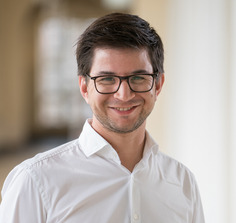
Chase Broedersz received his PhD cum laude from Vrije Universiteit Amsterdam in 2011, focusing on the mechanics and dynamics of biopolymer networks. He then joined Princeton University as a Lewis-Sigler Fellow, where he conducted independent research on the physics of living systems as an associate research scholar and lecturer.
In 2015, Broedersz established his research group at Ludwig-Maximilians-Universität in Munich, where he was appointed W2-Professor in statistical and biological physics and received tenure in 2020. From 2017 to 2020, he was a member of the Young Academy of the Bavarian Academy of Sciences and Humanities.
In 2020, he returned to Vrije Universiteit Amsterdam as an associate professor. He was awarded an ERC Consolidator Grant in 2023 and an NWO Vici grant in 2025, and in 2025 was appointed to the prestigious University Research Chair Professorship. He currently serves as Professor of Theoretical Physics of Life and director of the Physics and Astronomy joint degree BSc program.
Chase Broedersz | Physics Living Systems | Department of Physics and Astronomy